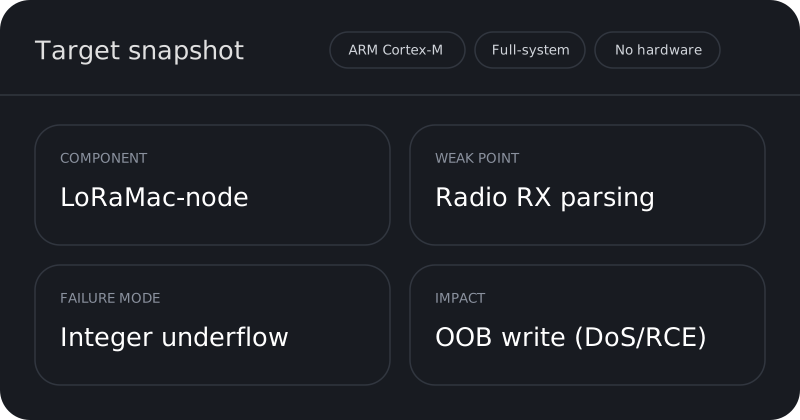
Effortless security testing for embedded software.
Expose hidden bugs using scalable automated fuzz testing without hardware. Ship embedded software faster, safer, and always compliant.



For Medical Devices
Validate safety-critical firmware and meet regulatory requirements through automated, hardware-free security testing.
FDA & EU MDR readiness
Evidence-based security reports
Early detection of critical failures
No hardware required for validation

For Automotive Systems
Secure ECUs and in-vehicle controllers by fuzzing full automotive firmware stacks before vulnerabilities reach production.
ECU & controller firmware testing
Wireless & interface attack surface analysis
Vulnerability detection
Coverage growth across full system paths

For Critical Infrastructure
Analyze complex embedded systems like smart meters and controllers with full visibility into firmware behavior over time.
Deep system visibility & detail views
Time-travel debugging of firmware states
Detection of vulnerabilities and errors
Scalable testing without physical devices
For Smart Systems & IoT
Protect connected devices by continuously testing firmware against real-world attack scenarios in a fully virtual environment.
Binary-only testing for IoT devices
Early detection of remote attack vectors
Automated fuzzing at scale
Clear resolution from bug detected to fixed
Helped secure millions of embedded devices ...







Backed by research and innovation programs ...


Trusted by ...


Helped secure millions of embedded devices ...
Backed by research and innovation programs ...
Trusted by ...

Fuzz what you ship.
Fuzzware brings clarity to the black box of embedded software.
We remove the hardware barrier from embedded software testing.
So teams can test deeper, ship faster, and trust their software.
Built on intelligent foundations
Fuzzware combines advanced emulation, automated fuzzing, and intelligent analysis to uncover vulnerabilities hidden deep inside firmware. Under the hood, powerful systems work together to make testing faster, safer, and more insightful.
No Hardware Needed
Fuzzware enables efficient security testing without physical hardware. Through advanced firmware rehosting, it delivers a scalable and cost-effective analysis, simplifying processes and eliminating logistical overhead.
Binary Only
Fuzzware tests binaries directly, allowing closed-source and third-party firmware to be analyzed without exposing source code. It strengthens supply-chain security while keeping intellectual property protected.
Full System Fuzzing
Unlike conventional tools, Fuzzware fuzzes the complete system as it runs in production. This ensures realistic results and full coverage, not just isolated component testing.



Fuzz smarter to
ship faster.
Fuzzware automates the whole process of testing firmware, from emulation to discovering security vulnerabilities. Each feature is designed to simplify complex workflows and deliver actionable security insights faster.
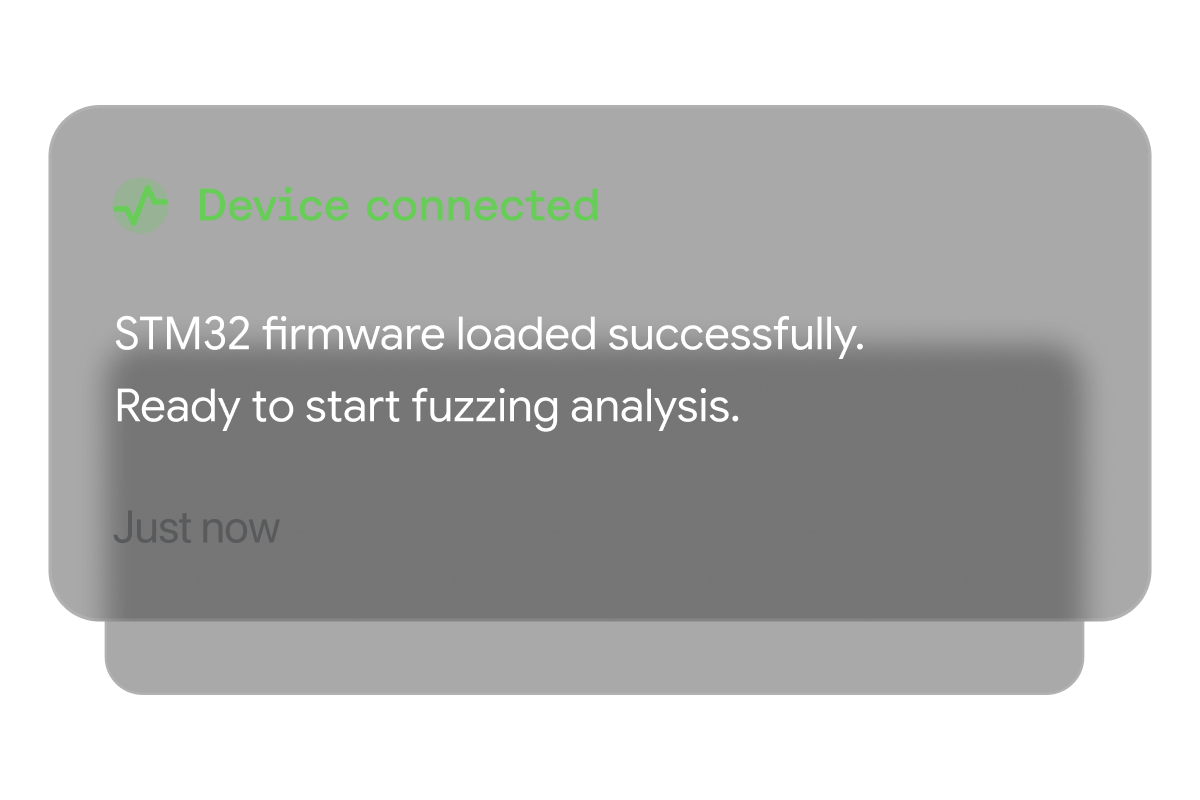
no hardware required.
Fuzzware rehosts firmware binaries into a fully virtual execution environment, eliminating the need for hardware, cables, or manual configuration. Peripherals, memory mappings, and execution contexts are handled automatically, allowing teams to run large-scale security testing faster and with significantly lower operational overhead. The result is repeatable, scalable firmware analysis that fits seamlessly into modern CI-driven development workflows.
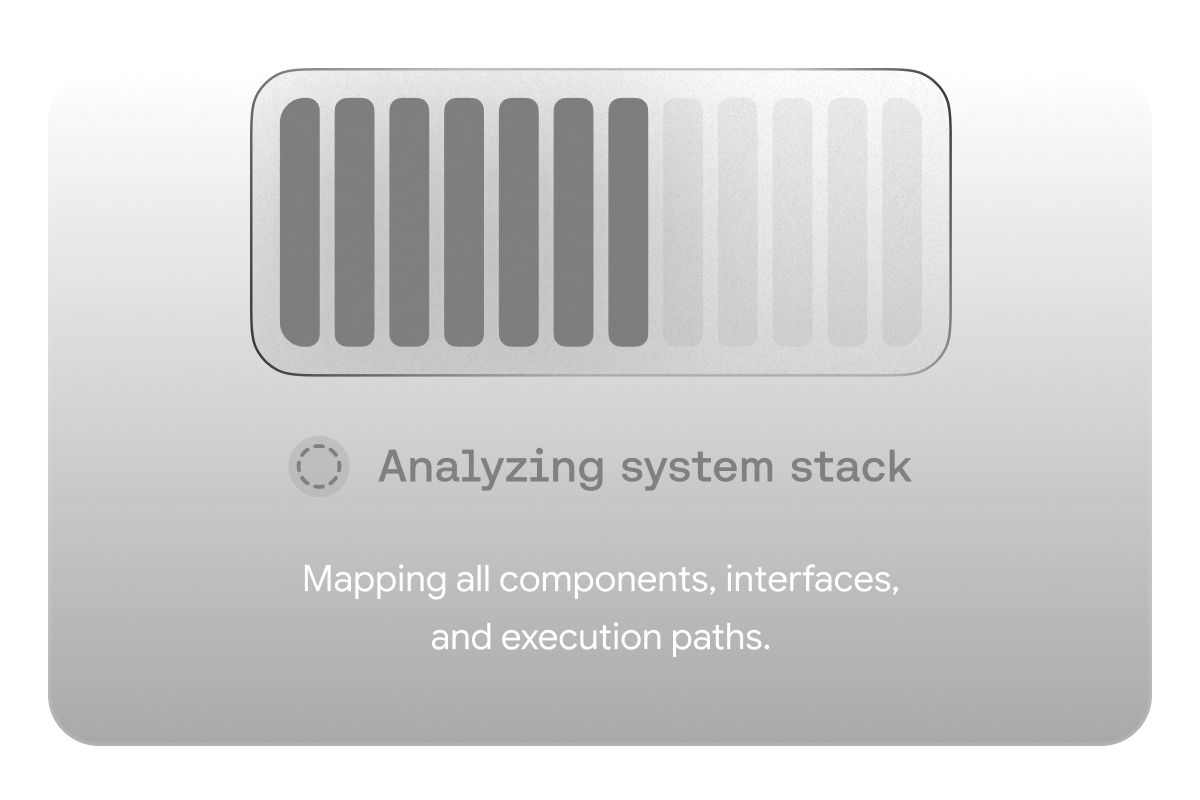
Fuzzware executes fuzzing campaigns against the complete firmware system, including all interacting components, interfaces, and execution paths. Instead of testing individual modules in isolation, the platform mirrors real-world behavior and data flows, uncovering vulnerabilities that only emerge at the system level. This results in more realistic findings, higher coverage, and security insights that reflect how firmware actually behaves once deployed.
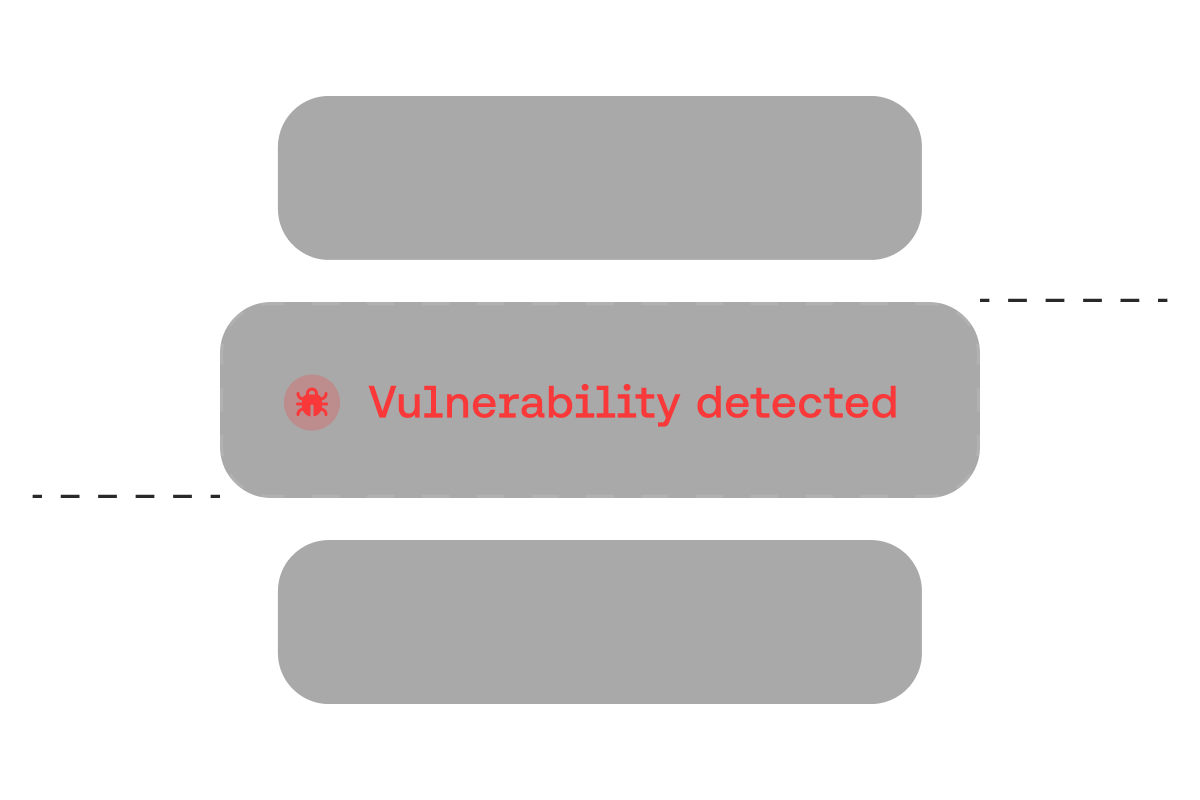
Fuzzware explores complex execution paths that are often missed by traditional testing approaches. By combining automated fuzzing with intelligent execution guidance, the platform drives inputs deeper into the firmware logic, exposing hidden flaws that surface only under specific runtime conditions. This enables faster discovery of high-impact vulnerabilities and provides security teams with actionable findings earlier in the development cycle.
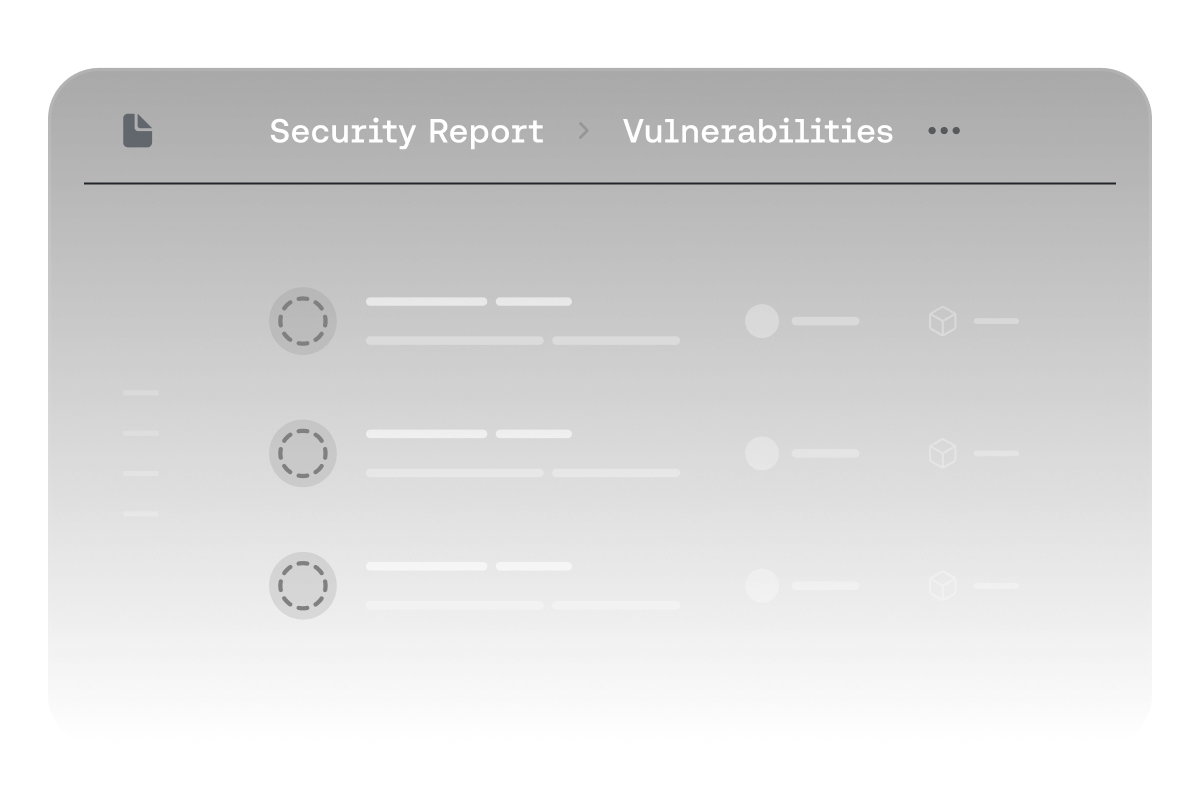
Fuzzware transforms detected vulnerabilities into structured, developer-ready security reports. Each finding is enriched with contextual execution data, reproducible inputs, and severity classification, making it easy to understand root causes and prioritize fixes. This shortens remediation cycles, improves collaboration between security and engineering teams, and ensures vulnerabilities move efficiently from detection to resolution.

Fuzzware operates directly on firmware binaries, eliminating the need for source code access. This enables effective security testing across proprietary systems, third-party components, and supply-chain firmware while keeping intellectual property fully protected. Teams can assess real-world attack surfaces without compromising confidentiality or vendor boundaries.
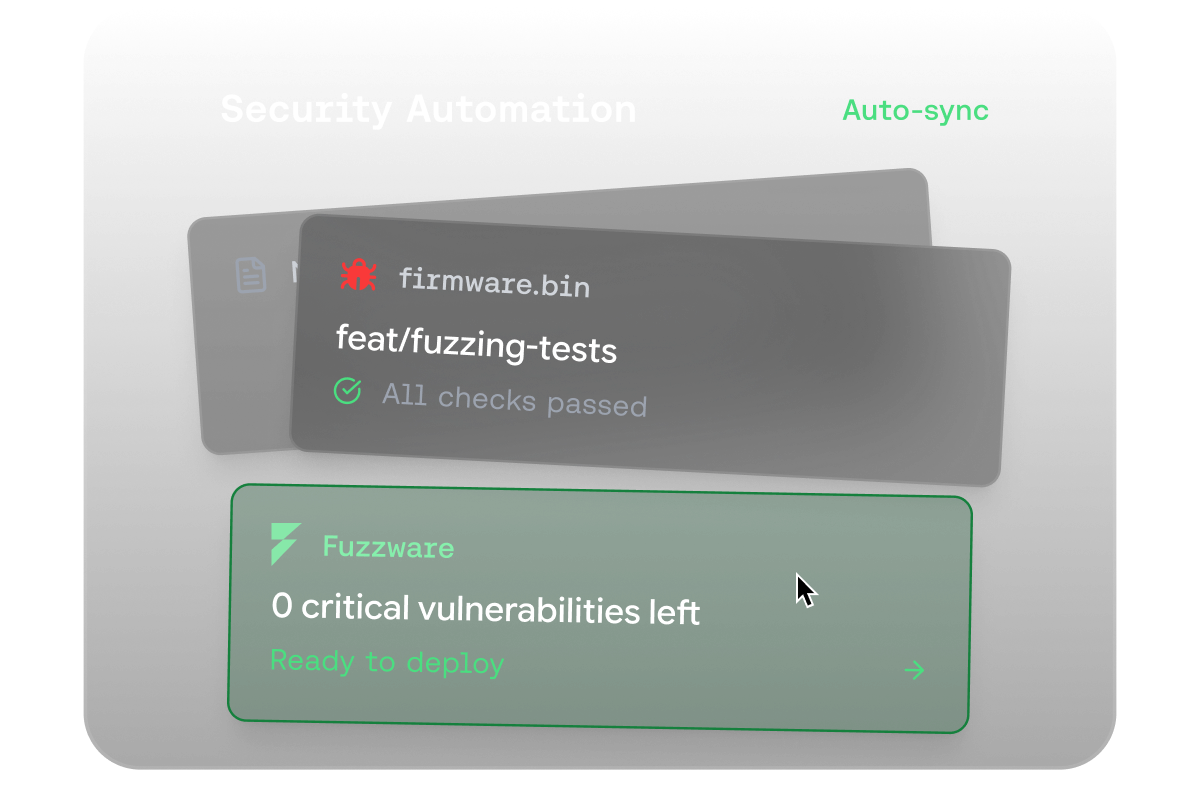
built for automation.
Fuzzware is built to run alongside development workflows. Firmware binaries can be tested on every release, enabling teams to detect regressions and newly introduced vulnerabilities early. This eliminates the need for additional infrastructure or slows down development by transforming security testing from a late-stage bottleneck to an automated safeguard.
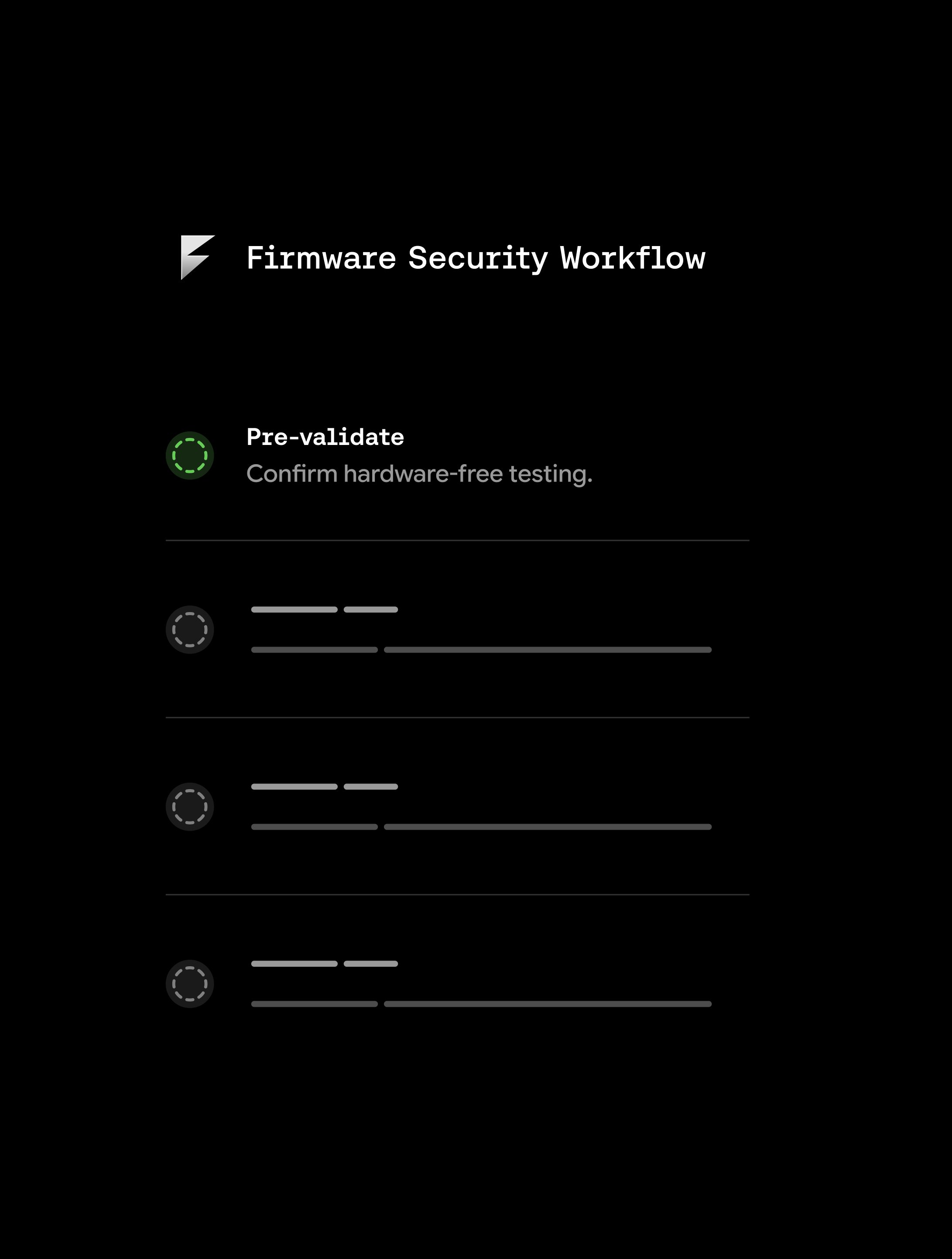
Technical pre‑validation to confirm firmware is ready for hardware‑free testing
Before testing begins, the Fuzzware team evaluates the target firmware binary to confirm architecture, execution behavior, and rehosting feasibility. This ensures the firmware can be analyzed effectively without physical hardware or source code access.
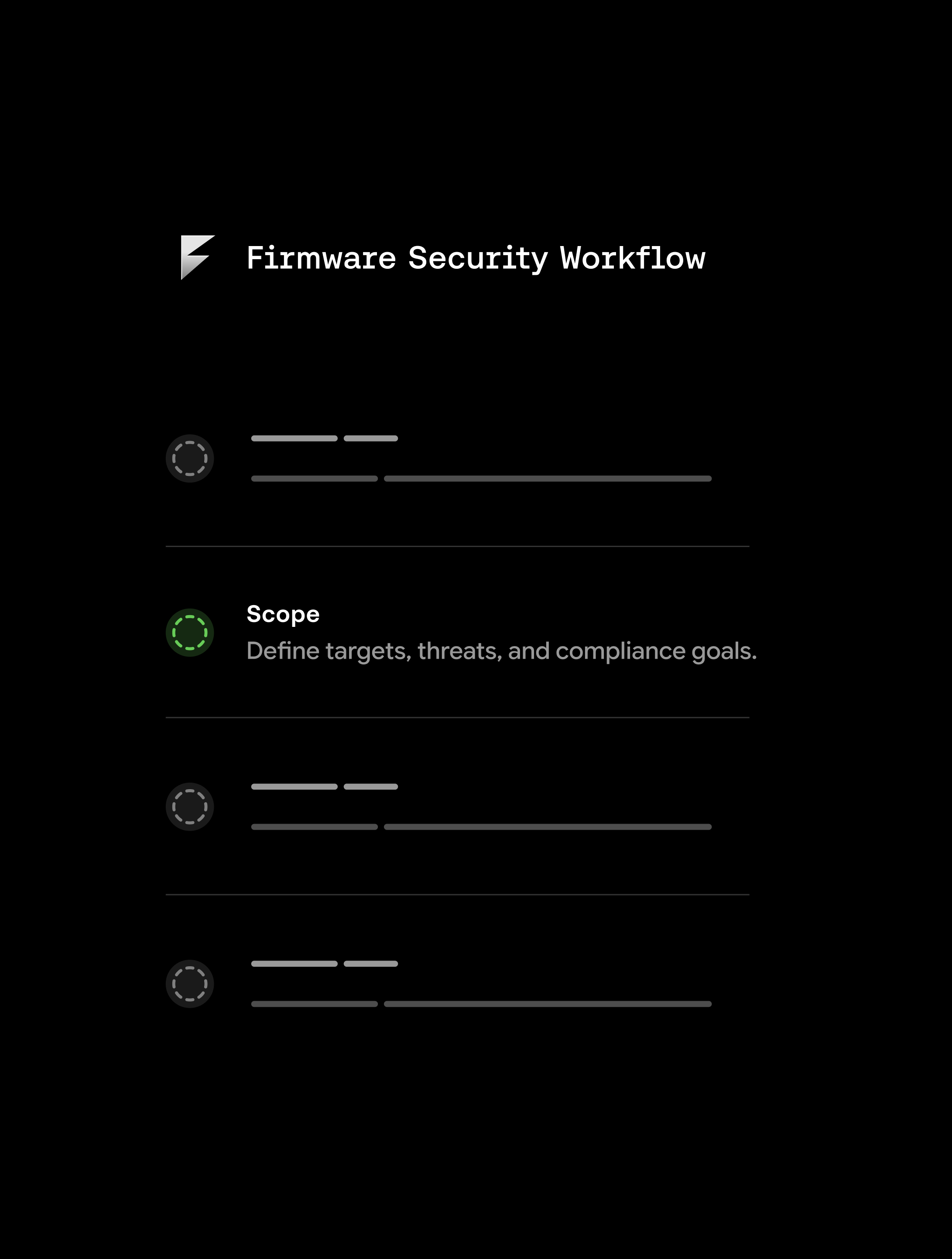
Test scoping to align the fuzzing campaign with risk and standards
Together with the customer, Fuzzware defines the testing scope and security objectives, including relevant components, threat models, and compliance requirements. This ensures coverage aligns with real-world risk and regulatory needs.
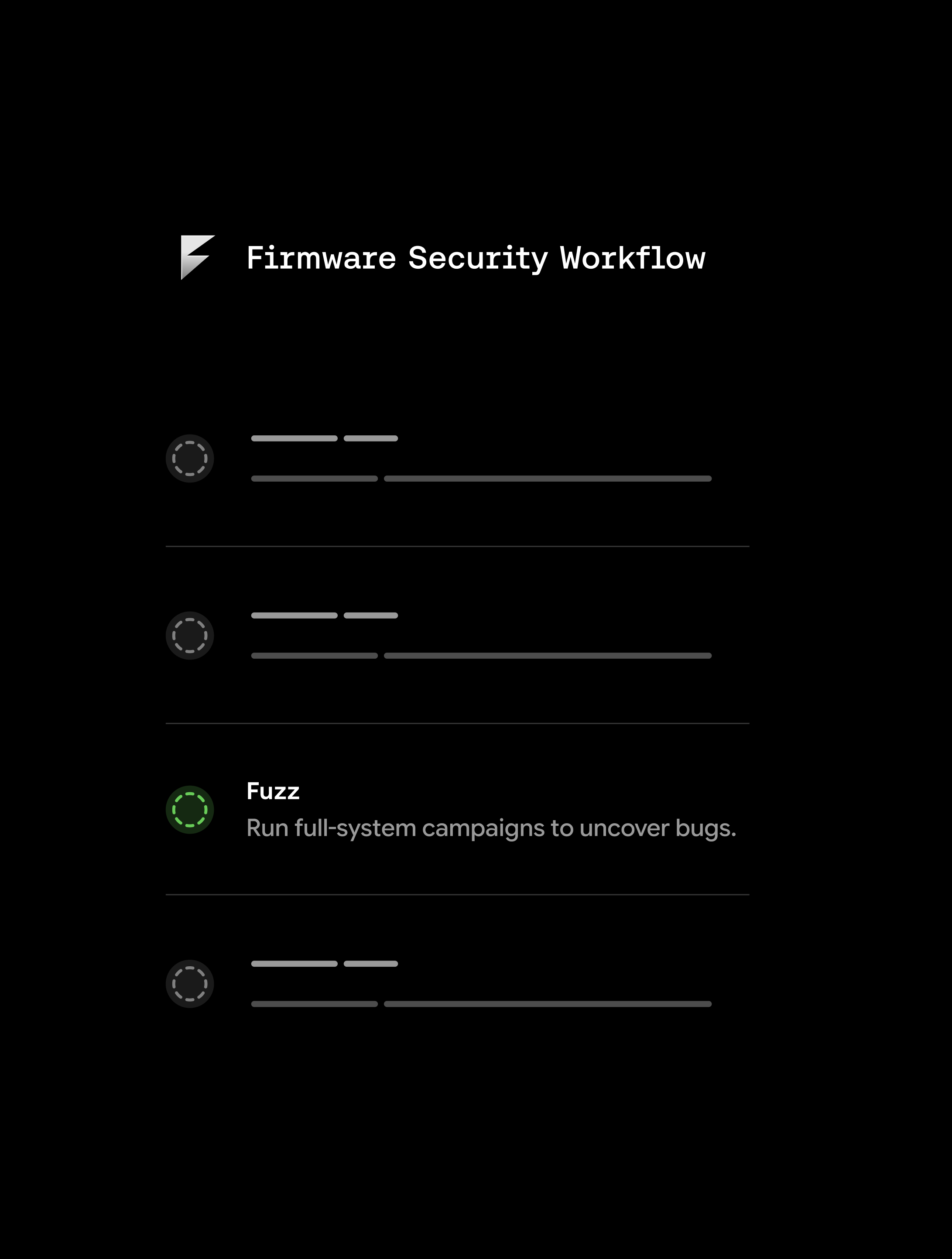
Fuzzing campaign running full‑system, automated fuzzing at scale
Fuzzware executes an automated, full-system fuzzing campaign to uncover vulnerabilities under realistic runtime conditions. Findings can be reviewed iteratively, enabling validation, refinement, and early remediation where needed.
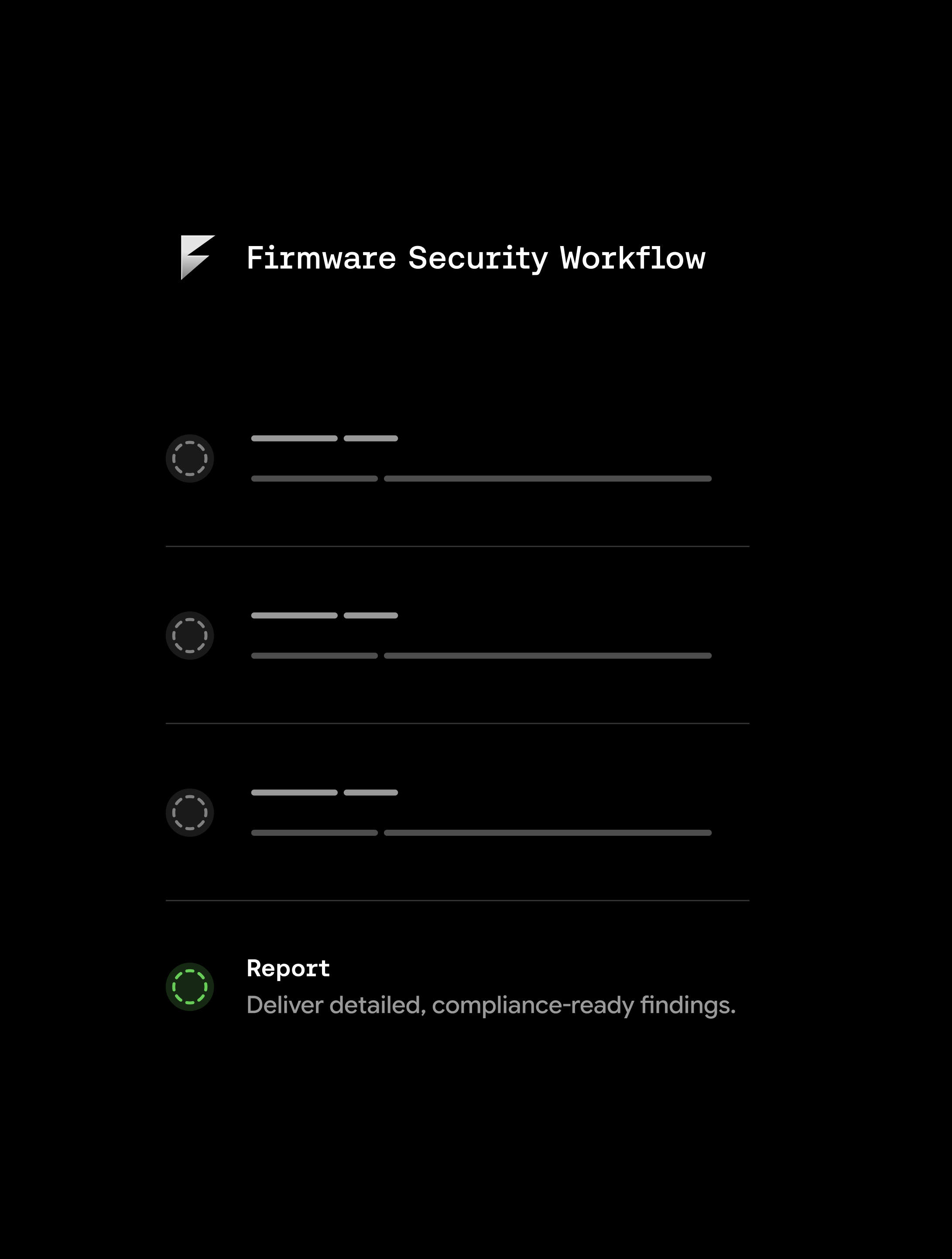
Detailed report to turn findings into clear actions for engineering
Fuzzware delivers a detailed security report with vulnerability findings, coverage metrics, and severity classification. Documentation is prepared to support engineering teams and meet standards such as ISO 21434 and UN R155.

From firmware analysis
to compliance-ready results
Fuzzware supports security teams from deep firmware analysis to compliance-ready results by combining automated fuzzing, expert research, and structured documentation.

End-to-end
fuzzing audit
Our experts perform a full end-to-end audit of your embedded software. We require only your compiled software to start the audit.

Compliance
guidance
Are the fuzzing results required for compliance? We can help you document the test in a compliance-ready manner.

Vulnerability
Verification
Found vulnerabilities are classified and verified by our experts. We provide a detailed report and meaningful solution recommendations.


From Academic Excellence to Industry Innovation
Fuzzware was founded by Simon Wörner and Tobias Scharnowski, two PhD researchers from CISPA Helmholtz Center whose award-winning firmware fuzzing research is now transforming embedded systems security for companies worldwide.

Tobias is Research Lead at Fuzzware with a doctoral research background at CISPA Helmholtz Center for Information Security. His research focuses on the automated security analysis for embedded software. Tobias invented the hardware modeling technique that powers Fuzzware. As a CTF veteran and repeat Pwn2Own participant, he has earned the "Master of Pwn" title and demonstrated practical exploits in automotive and industrial automation domains, including critical vulnerabilities in the DNP3 protocol that powers the US electric grid.

Simon is a PhD researcher at CISPA Helmholtz Center for Information Security, specializing in embedded systems security and firmware fuzzing. His research focuses on innovative fuzzing techniques for firmware analysis. With multiple publications at leading conferences, including USENIX Security, he brings deep technical expertise to Fuzzware's product development.
Have Questions About Firmware Fuzzing?
Connect with the team to explore how Fuzzware fits your security workflow.
Frequently Asked Questions
Get answers to common questions about Fuzzware's hardware-free fuzzing approach, technical capabilities, and how we help teams secure their embedded systems faster and more effectively.
Fuzzware performs comprehensive full-system fuzzing that tests your firmware exactly as it runs in production. Unlike isolated unit tests, we analyze the complete interaction between software components, peripheral interfaces (MMIO), and interrupt handlers. Our automated analysis identifies vulnerabilities such as memory corruptions, buffer overflows, and use-after-free bugs in both first-party and third-party firmware binaries. We focus on discovering security-critical issues that could lead to exploitation, privilege escalation, or denial of service in your embedded devices.
Static analysis examines code without executing it, which can miss runtime vulnerabilities and produce false positives. Penetration testing requires physical hardware and extensive manual effort. Fuzzware solves these shortcomings through a full-system dynamic analysis: we automatically execute your firmware in a virtual environment, testing real execution paths under realistic conditions. This approach achieves significantly higher code coverage than static tools while being infinitely more scalable than manual penetration testing. Our technique discovers vulnerabilities that traditional methods miss, especially in complex firmware interactions.
Fuzzware currently supports a wide range of ARM Cortex-M architectures (M0, M3, M4, M7), which are used in the majority of embedded systems across industries, including medical devices, IoT, automotive, and industrial control systems. Our emulation framework accurately models Memory-Mapped I/O (MMIO) interactions, allowing us to test firmware without requiring physical hardware specifications. We continuously expand our architecture support based on customer needs. If you're working with a specific architecture, contact us to discuss compatibility and potential support.
Fuzzware is specifically designed to work with binary-only firmware, requiring no source code or documentation. This makes us uniquely suited for analyzing closed-source components, third-party libraries, and legacy firmware where source code is unavailable. Our advanced emulation and analysis techniques automatically model hardware interactions and identify security vulnerabilities purely from the compiled binary. This capability is essential for a comprehensive security assessment of modern embedded systems that integrate multiple proprietary components from different vendors.